
Research Paper: 100% Elimination of Hallucinations on RAGTruth for GPT-4 and GPT-3.5 Turbo
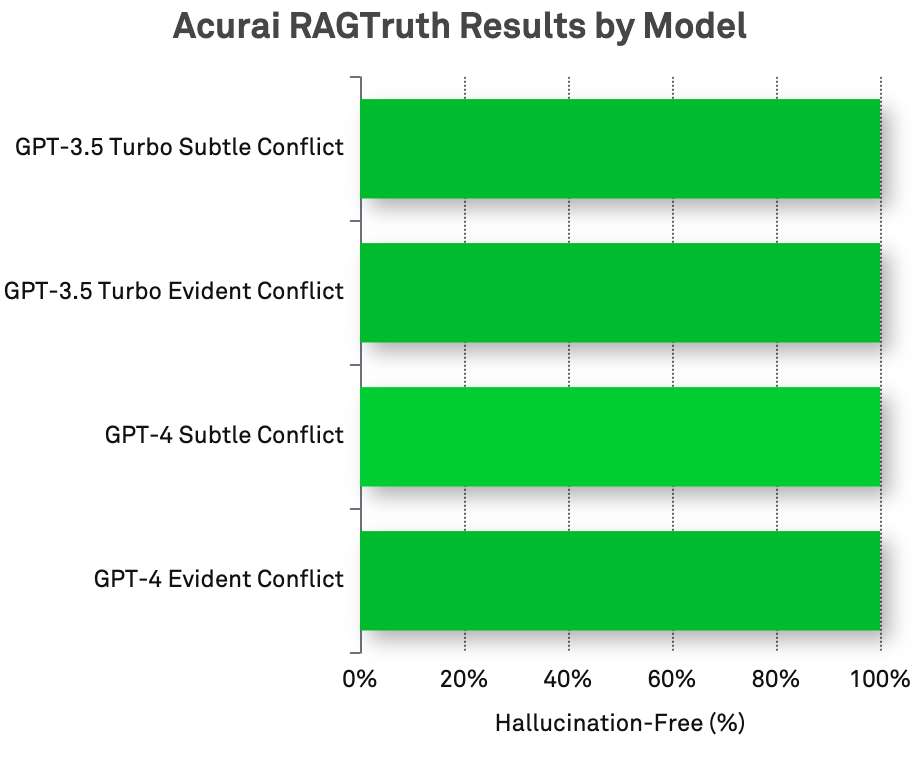
The Acurai research paper is the first study to achieve 100% hallucination elimination — removing every Evident and Subtle Conflict for GPT-4 and GPT-3.5 Turbo on the independent RAGTruth corpus, with a 91%–100% confidence interval. Here is how the methodology works and how to apply it today.
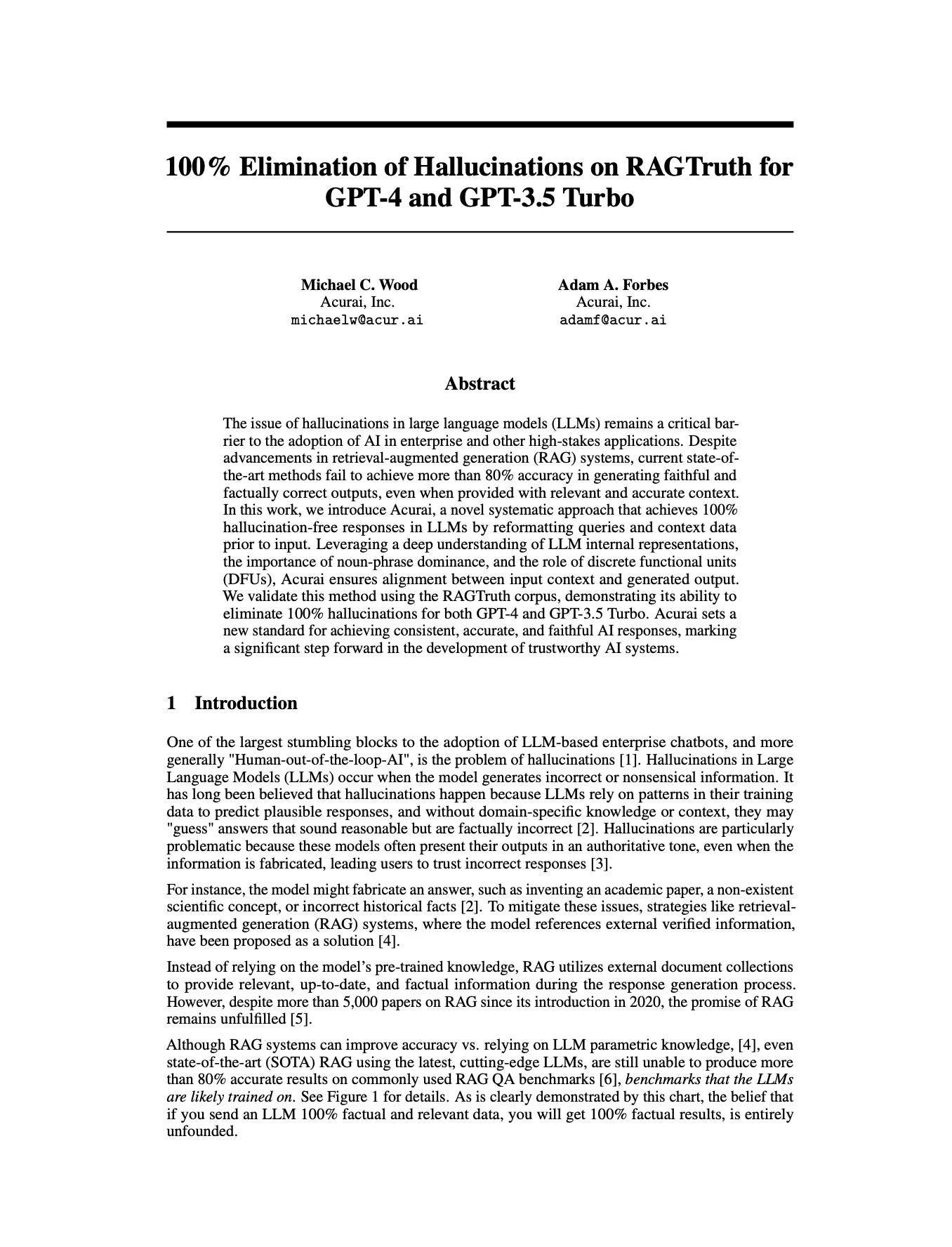
The Acurai research paper discloses three methods for removing noun-phrase collisions, and thereby producing 100% accurate, hallucination-free responses.
While the study is self-explanatory, I’d like to highlight the following sections:
- The methodology used, and its application to real-world hallucination elimination.
- The study’s results, including the confidence interval.
- The three methods for removing noun-phrase collisions.
- Recommendations for additional research.
Acurai Study Methodology and Implications
It’s important to note that Acurai was used exclusively on RAG query and passage combinations that were known to cause hallucinations in the studied models. It was not studied on general RAG QA.
In other words, Acurai was studied to assess how well it corrected already identified hallucinations, as documented in the RAGTruth corpus. Acurai eliminated 100% of the Evident and Subtle Conflicts for GPT-4–0613 and GPT-3.5-Turbo-0613.
Because the study focused on hallucination correction, it’s advisable to use Acurai in the same manner. In other words, use your standard RAG pipeline along with a hallucination detection methodology. If the response is likely a hallucination, rerun the same query and passages through Acurai. Otherwise, simply send the original response to the user.
Doing this also helps mitigate the cost and latency issues mentioned in the study. 100% hallucination elimination comes at a cost in terms of both latency and added token expense. Thus, if your RAG is 80% accurate, you only need to incur the latency and token costs 20% of the time.
Acurai Study Confidence Interval
The combination of the four datasets was sufficiently large to establish a confidence interval of 91% to 100% (using the Wilson Score Interval). Hence, the expected worst case scenario in the general population is an elimination of 91% of hallucinations. (The expected best-case scenario is 100% hallucination elimination.)
This expectation only applies when Acurai is used in the same manner as it was in the study. For example, the RAGTruth corpus includes three passages for every query. The present study did not measure Acurai’s effectiveness when hundreds or thousands of chunks are sent along with each query. That remains an open research opportunity. (See below.)
If your RAG pipeline generally sends the top 3–5 chunks to the LLM then the confidence interval certainly applies to your current chatbots. You can literally eliminate hallucinations today.
If your RAG pipeline generally sends numerous chunks, Acurai may provide complete hallucination elimination. As noted in the study, Acurai needs to either be tested in such environments; or a RAG system needs to be developed that can pinpoint relevant chunks in knowledge stores containing millions of documents (which currently remains an open problem).
Acurai’s Method For Eliminating Hallucinations
For those who are following my tutorial on eliminating hallucinations, you will want to note that the Acurai study includes three methods of removing noun-phrase collisions; thereby eliminating hallucinations.
I highly recommend that you read the paper to learn about these methods.
Research Opportunities
The Acurai research paper is the first study to achieve 100% hallucination elimination, creating an exciting opportunity for additional research by the data science community. Some example studies can include:
- Testing Acurai using hundreds (or even thousands) of chunks.
- Testing Acurai on additional models outside the ChatGPT family.
- Creating new methods for removing/avoiding noun-phrase collisions and testing the degree to which such methods eliminate hallucinations.
- Etc.
A Landmark Achievement in AI
Skeptics long argued that eliminating hallucinations in large language models was a theoretical impossibility. The Acurai study proves them wrong.
The Acurai study represents a defining moment in the pursuit of artificial general intelligence. By achieving a 100% elimination of hallucinations on a rigorously independent dataset, it sets a new standard for what’s possible.
This 100% success isn’t just a milestone — it’s a transformative leap that redefines the potential of AI, setting the stage for AGI to be a trusted partner in the human journey.